Torrone: Italian Nougat Candy
There’s something about Italian Torrone that instantly brings the holidays to life. Maybe it’s the way the wrapper crackles when you open it. Maybe it’s that first soft, chewy bite filled with honey and roasted nuts. Or maybe it’s because Torrone is one of those old Italian sweets that appears only once a year, making it feel extra special every time it hits the table.
Torrone has been part of the Italian Christmas season for centuries. Long before gift boxes and cookie platters, it was already a holiday tradition.
A Story That Begins in Cremona
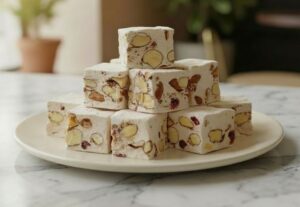
Its history reaches back to 15th-century Cremona. According to legend, it was served at a royal wedding banquet. It was shaped to resemble the city’s cathedral tower, the Torrazzo. That’s where the name “Torrone” came from.
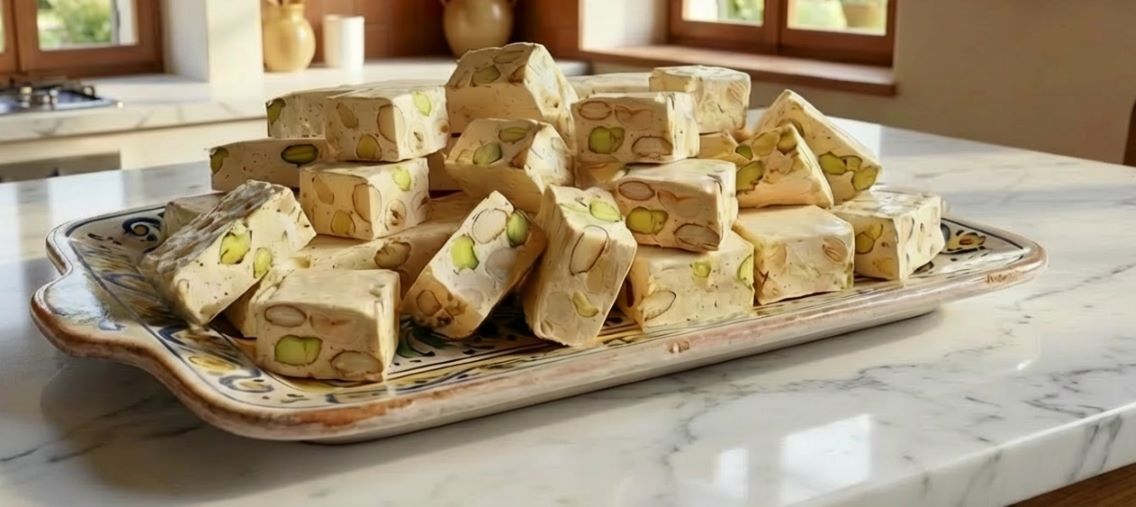
Every region of Italy has its own version. Some are soft and pillowy. Others are firm and snappy; some are packed with toasted almonds and others use pistachios or hazelnuts.
But the name isn’t why people love it today. Torrone is about that shared moment when someone slices a piece and passes it around. Suddenly the whole room smells like honey, almonds, and nostalgia.
Typical Ingredients in Italian Torrone
Edible Wafer Paper – Often used to line the top and bottom of Torrone, keeping it from sticking.
Honey – The heart of the nougat, giving it sweetness and that warm, aromatic flavor.
Sugar – Usually granulated, sometimes combined with honey to achieve the perfect chewiness.
Egg Whites – Whipped to a soft, airy consistency, they create the nougat’s light, tender texture.
Nuts – Traditionally almonds, but pistachios, hazelnuts, or a mix are common too.
Optional Flavorings – A touch of vanilla, citrus zest, or even cinnamon for extra aroma.
A Sweet Slice of Italian Tradition

For many, Torrone carries personal stories. Maybe it’s an aunt who brought a box every Christmas. A grandfather who kept slices hidden in a tin. Those late-night holiday gatherings where everyone claimed they were “too full” but still took one more bite. Even if you’re trying it for the first time, it feels familiar and welcoming.
It’s a treat that quietly brings people together. Italian Torrone isn’t just a candy. It’s a small piece of Italian tradition. A sweet reminder to slow down and enjoy the season.
Ingredients
Equipment
Instructions
- Prepare the pan: A 9×9-inch pan with parchment or wafer paper. Leave some overhang for easy removal.
- Toast the nuts (if not pre-roasted): Preheat oven to 350°F (175°C). Toast hazelnuts and almonds for 8–10 minutes, stirring once. Let cool and set aside.
- Melt the honey and sugar: In a heavy-bottomed saucepan, heat honey and sugar over medium heat, stirring until dissolved. Simmer gently without stirring until it reaches 250°F (121°C) on a candy thermometer (hard ball stage). This takes about 10–15 minutes.Stir often and monitor carefully to prevent burning.
- Whip egg whites: While the syrup is cooking, beat egg whites with a pinch of salt until stiff peaks form.You’ll fold these into the hot sugar-honey mixture later.
- Combine Sugar-Honey with Egg Whites: Slowly pour the hot honey-sugar mixture into the whipped egg whites while mixing on low speed.Once combined, increase the mixer speed to medium-high. Beat until the mixture is glossy and starts to thicken (5–8 minutes).
- Add Nuts and Flavor: Quickly fold in the toasted nuts, vanilla, and citrus zest (if using) with a spatula. The mixture will be thick and sticky.Work quickly—Torrone sets as it cools.
- Shape the Torrone: Pour the mixture into the prepared pan. Use a spatula (lightly oiled or wet) to smooth the surface. Allow to cool at room temperature for 6 hours until firm, then refrigerate for at least 5 hours or overnight.Cover with parchment or wafer paper, pressing gently.
Notes
Nutrition Estimated Facts
Italian Torrone
Serving Size: 1 piece (Approx. 40g)
| Nutrient | Amount | % DV |
|---|---|---|
| Calories | 170 kcal | — |
| Total Fat | 7 g | 9% |
| Saturated Fat | 1 g | 5% |
| Cholesterol | 5 mg | 2% |
| Sodium | 20 mg | 1% |
| Total Carbohydrates | 24 g | 9% |
| Dietary Fiber | 1 g | 4% |
| Added Sugars | 18 g | 36% |
| Protein | 3 g | — |
The majority of calories come from honey and sugar (carbohydrates) and almonds or other nuts (fats). The nuts contribute most of the fat content, while added sugars account for a significant portion of the carbohydrate load.
Tried this recipe?
Let us know how it was!Italian Chocolate Torrone
The chocolate torrone we adore today is a delicious evolution of an old-world classic. Over time, southern Italian regions—especially Campania and Sicily—put their own spin on the medieval treat, blending in silky chocolate, toasted nuts, and even bits of dried fruit. What started as a traditional nougat became a richer, more indulgent holiday favorite that continues to win hearts every Christmas. Chocolate Torrone Recipe
Variations: Soft vs. Firm Torrone
Soft Torrone (Torrone Morbido)
If you love a nougat that’s chewy, tender, and melts as you bite into it, go for the soft version.
Here’s how to achieve it:
Lower the cooking temperature.
Heat the honey and sugar mixtures to a slightly lower temperature (around 250–255°F / 121–124°C). This keeps the texture pliable and soft.
Add a touch of fat.
A small amount of cocoa butter, coconut oil, or even a spoonful of butter helps keep the torrone creamy.
More honey, less sugar.
Honey gives softness; sugar brings firmness. Adjusting the ratio makes a noticeable difference.
Fold in add-ins gently.
Soft torrone works beautifully with toasted almonds, pistachios, hazelnuts, or even a mix.
You can also add candied citrus, vanilla bean, orange blossom water, lemon zest
Firm Torrone (Torrone Duro)
Firm torrone is the kind you break with a snap and often find in bars wrapped in crisp paper. It’s crunchy, clean, and satisfying.
Here’s how to make the firmer style:
Cook the sugar mixture hotter.
Aim for 290–300°F / 143–149°C. This helps the torrone set with that classic brittle bite.
Use more sugar than honey.
Sugar creates structure. Increasing it will help the candy hold a tight, crisp shape.
Skip the added fats.
No butter or oils, this keeps the texture clean and firm.
Work quickly.
Once the nuts go in, the mixture sets fast. Have everything lined up in advance.
Firm torrone is perfect for gifting or adding to cookie trays because it keeps its shape beautifully and has a satisfying, candy-bar crunch.
Flavor Variations
Regardless of soft or firm style, you can mix things up with fun, festive twists:
Pistachio + Orange Zest — fresh, vibrant, and very Sicilian.
Hazelnut + Chocolate Drizzle — think Italian gianduja meets holiday candy.
Almond + Lemon — bright and traditional.
Mixed Nuts + Honey — rustic and classic.
Vanilla Bean + Sea Salt — a modern twist that balances sweetness.
Espresso Torrone — add espresso powder for a grown-up, aromatic version.
Serving Italian Torrone
Pair with espresso or cappuccino.
A small cube of torrone and a strong Italian coffee feels like a treat straight from a café in Rome. The bitterness of the coffee balances the sweetness perfectly.
Enjoy it with dessert wines.
Serve small pieces with Vin Santo, Moscato d’Asti, Passito, or any lightly sweet dessert wine. They complement the honey tones in the candy.
Keep portions small.
Torrone is sweet and rich. Bite-size slices make it feel special without overwhelming the palate.
Set it out on a holiday dessert board.
Torrone looks beautiful next to cookies, chocolate-dipped fruit, biscotti, and citrus slices. Its bright white color adds a pretty contrast.
Serve with fresh fruit.
Orange wedges, figs, or berries add freshness and a bright, juicy element that pairs beautifully with the nutty nougat.
Crumble it over gelato or ice cream.
A sprinkle of chopped torrone over vanilla, pistachio, or almond gelato is downright dreamy. It adds crunch, sweet honey flavor, and visual appeal.
Storage
Storing torrone is easy, and it actually keeps beautifully, just like the old Italian Christmas candies our grandparents tucked away in tins.
Keep it in an airtight container: Moisture is the enemy. A sealed tin or container keeps the texture just right, whether it’s soft and chewy or firm and snappy. Separate layers with parchment, Torrone can stick to itself, especially the soft kind. Slip parchment between layers to keep the pieces neat.
Store at room temperature: A cool, dry spot in your kitchen or pantry is perfect. Avoid heat, which can soften it too much, and avoid the fridge, which can make it sticky or overly hard. The flavor actually improves after a day or two as the honey and nuts meld together. So don’t worry about making it ahead.
Soft torrone: Lasts about 2–3 weeks
Firm torrone: up to 1 month
Freeze: Yes, especially the firm variety. Wrap pieces tightly in parchment., place in a freezer bag or airtight container. Freeze for up to 3 months.
Let it come to room temperature before serving so the texture settles back into place.