
Ingredients
Equipment
Instructions
Dough
- To make the pastry, begin by placing the flour and salt in a large mixing bowl. Add the honey and gradually mix in the water until a stiff dough is formed.
- Transfer the dough to a clean work surface and knead it for a few minutes until it becomes soft and pliable. Wrap the dough in cling film and refrigerate it for 30 minutes to allow it to rest.
- Divide the dough into four equal pieces to make it easier to roll out. Take one piece of dough and roll it through a pasta machine, similar to making pasta. Start by rolling it at the widest setting, then fold it in half and roll it again. Repeat this process two more times to create a smooth sheet of dough. Gradually decrease the width settings on the pasta machine with each roll.
- Once the sheet of dough is very thin, approximately 1mm thick, place it on the work surface and spread a thin layer of softened lard or butter over it. Carefully roll up the sheet, starting from one of the short edges, to create a tight sausage shape.
- Repeat the rolling and filling process with the remaining pieces of dough, rolling each one into a thin sheet with the pasta machine and coating it with lard or butter. Roll each of these sheets around the original pastry sausage, layering them to form one large cylinder. Gently stretch out the dough with each layer. Wrap the assembled pastry tightly in cling film and refrigerate for 1-2 hours to firm up before using.
Filling
- To prepare the filling, take a pan and combine the milk, sugar, and salt. Bring the mixture to a boil and whisk in the semolina flour until it thickens and becomes smooth. Transfer the mixture to a bowl and let it cool slightly. Then, beat in the remaining ingredients until you achieve a smooth and thick cream. Transfer the filling to the refrigerator and chill it until needed.
- Preheat your oven to 390°F and place sfogliatelle on a baking sheet lined with parchment paper.
- Unwrap the pastry roll and use a sharp knife to cut it into slices about 1cm thick. With your fingers, gently flatten and push out the center of each slice to create a shell or cone shape. You can grease your fingers with a little more softened lard or butter to make this process easier.
- Spoon a generous amount of the ricotta filling into the hollow of each pastry shell and gently press the edges of the pastry together to seal them. Repeat this process with the remaining pastry slices and filling, arranging the filled pastries on the lined baking tray.
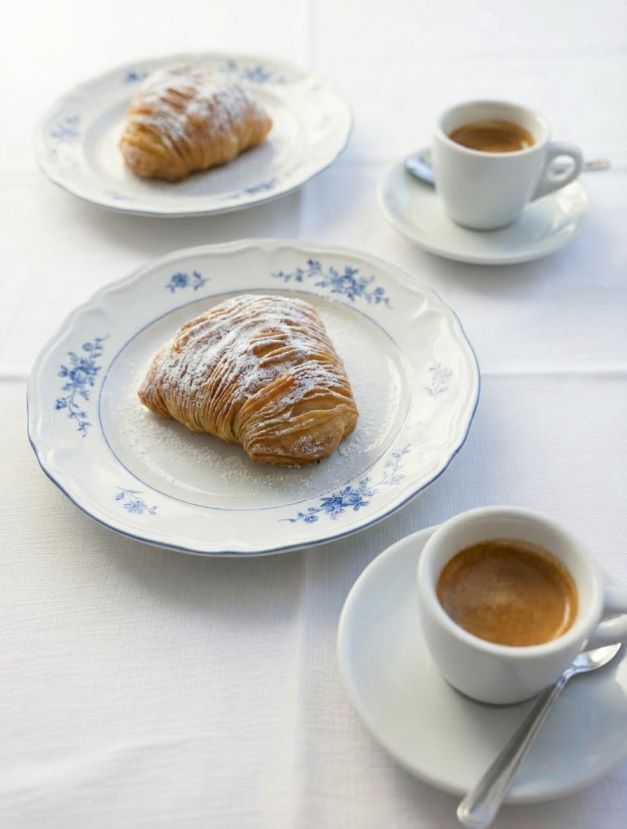
- Place the pastries in the preheated oven and bake for approximately 25 minutes, or until they turn golden brown and become crisp. Allow the pastries to cool, then dust them with a light sprinkling of icing sugar before serving.
Nutrition
Notes
Use lard, not butter for true Neapolitan texture. Lard creates crisp, well-defined layers that shatter when bitten. Butter melts too fast and softens the pastry.
Resting the dough is not optional: Proper resting relaxes the gluten, allowing the dough to stretch paper-thin without tearing.
Stretch slowly and evenly: Rushing the stretching process will cause uneven layers and dense spots in the pastry.
Apply lard generously between layers: Too little fat prevents proper separation and results in a tough shell.
Roll the dough tightly: A loose roll leads to poor lamination and a pastry that won’t open into its classic shell shape.
Keep the filling slightly grainy: Sfogliatelle filling should never be smooth like cheesecake texture from semolina is traditional.
Do not overfill: Too much filling will burst the layers and ruin the shell shape during baking.
Bake at a high temperature.: A hot oven is essential to create steam quickly and force the layers apart.
Dust with powdered sugar only after baking: Adding sugar before baking will melt and interfere with the crispness.
Higher fat content is traditional due to lard-based laminated dough Ricotta and eggs contribute to protein and calcium Candied citrus increases sugar and carbohydrates Naturally cholesterol-rich, typical of classic Italian pastries Percent Daily Values (%DV) are based on a 2,000-calorie diet.
Nutrition Facts (Approximate Per Cookie)
| Nutrient | Amount | % Daily Value* |
|---|---|---|
| Calories | 420 kcal | 21% |
| Total Fat | 22 g | 28% |
| Saturated Fat | 9 g | 45% |
| Trans Fat | 0 g | — |
| Cholesterol | 95 mg | 32% |
| Sodium | 180 mg | 8% |
| Total Carbohydrates | 46 g | 17% |
| Dietary Fiber | 2 g | 7% |
| Total Sugars | 24 g | — |
| Includes Added Sugars | 20 g | 40% |
| Protein | 10 g | 20% |
| Vitamin A | 350 IU | 8% |
| Vitamin C | 2 mg | 2% |
| Calcium | 160 mg | 12% |
| Iron | 2.6 mg | 14% |
| Potassium | 210 mg | 4% |
Higher fat content is traditional due to lard-based laminated dough Ricotta and eggs contribute to protein and calcium Candied citrus increases sugar and carbohydrates Naturally cholesterol-rich, typical of classic Italian pastries Percent Daily Values (%DV) are based on a 2,000-calorie diet.