
Ingredients
Equipment
Instructions
- Prep Dry IngredientsSift almond flour and powdered sugar together. Discard large bits. Set aside.
- Make the MeringueWhip egg whites on medium speed until foamy.Gradually add granulated sugar, then whip on high until stiff, glossy peaks form.Add food coloring if using.
- Macaronage (Folding the Batter)Fold sifted dry ingredients into the meringue gently using a rubber spatula.Mix just until the batter flows like lava and ribbons dissolve in about 10–15 seconds.
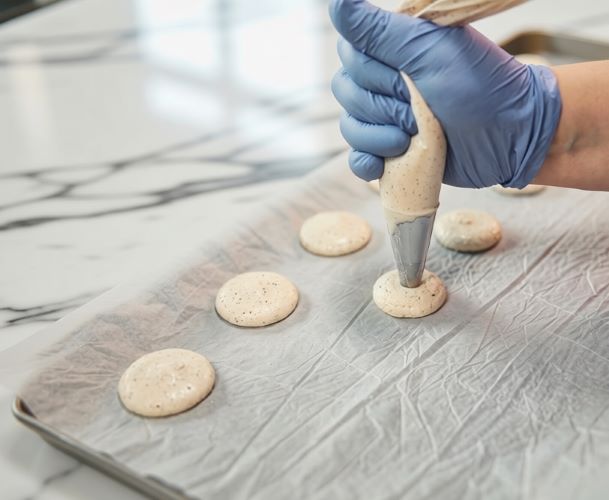
- Pipe the ShellsFill a piping bag and pipe 1.5-inch rounds on lined baking sheets.Tap the trays on the counter to release air bubbles. Pop bubbles with a toothpick.
- Rest the ShellsLet macarons rest for 30–45 minutes until they form a skin and are no longer sticky to the touch.
- BakePreheat oven to 300°F (150°C).Bake 12–14 minutes per tray until set with feet and dry tops. Do not brown.Cool completely before removing.
- Make the GanacheHeat cream until just simmering, then pour over chopped chocolate.Wait 1–2 minutes, stir until smooth, and add butter if desired.Let cool until thick enough to pipe.
- AssemblePair similar-sized shells.Pipe ganache on one shell, sandwich with another.Gently press to spread filling to the edge.
- Age in FridgeStore in an airtight container in the fridge for 24 to 48 hours.Let come to room temp before serving.
Notes
Use a kitchen scale if you can: Macarons are very sensitive to ratio changes. Even small differences in volume can throw off the batter. Weights = accuracy = success.
Use aged egg whites: Separate egg whites at least 24 hours ahead and store them in the fridge. Let them come to room temperature before using. Aging helps reduce moisture and creates a more stable meringue.
Sift your almond flour and powdered sugar well: A fine, lump-free dry mix helps create smooth macaron tops. You can also pulse almond flour with powdered sugar in a food processor for extra smoothness—just don’t overdo it or it may become oily.
Don’t under-mix or over-mix. The batter should flow like lava and form ribbons that melt back into the bowl in about 10–15 seconds.
Too thick? You under-mixed—it will crack in the oven.
Too runny? You over-mixed—it will spread too much and won’t rise.
Bake one tray at a time in the center rack: Too much heat from above or below can cause browning or uneven feet.
Most of the calories in French macarons come from sugar (in the shells and filling) and fat from almond flour and butter-based fillings, which give macarons their rich, tender texture.
Nutrition Facts (Estimated) — Per 1 French macaron (1 piece, about 22–25 g)
| Nutrient | Amount | %DV |
|---|---|---|
| Calories | 90 | — |
| Total Fat | 4 g | 5% |
| Saturated Fat | 1.5 g | 8% |
| Cholesterol | 10 mg | 3% |
| Sodium | 5 mg | 0% |
| Total Carbohydrate | 12 g | 4% |
| Dietary Fiber | 1 g | 4% |
| Total Sugars | 11 g | — |
| Added Sugars | 10 g | 20% |
| Protein | 2 g | 4% |