
Ingredients
Equipment
Instructions
Dough
- DoughMix lukewarm milk with yeast; let stand 5 minutes.Add eggs, sugar, flour, and salt (place salt away from the yeast).Mix until dough forms; knead 8–10 minutes.Add softened butter gradually; knead another 8–10 minutes until smooth.Let rise 1½ hours.
- ShapeDivide dough into 36 pieces (~1.4–1.6 oz each).Roll into balls, place on baking sheets.Rise again 45–60 minutes.
- Bake350°F (180°C) for 12–15 minutes, pale and soft.Cool completely before filling.
Filling
- FillingWhip heavy cream to soft peaks.In another bowl, beat ricotta, mascarpone, powdered sugar, and vanilla until smooth.Fold whipped cream into the ricotta–mascarpone mixture.Chill 30 minutes.
- FillPipe filling into each brioche puff.Dust generously with powdered sugar.
Notes
Drain the Ricotta Well: Ricotta holds more moisture than you might think. If it’s too wet, the filling becomes loose and won’t hold its shape inside the pastry.
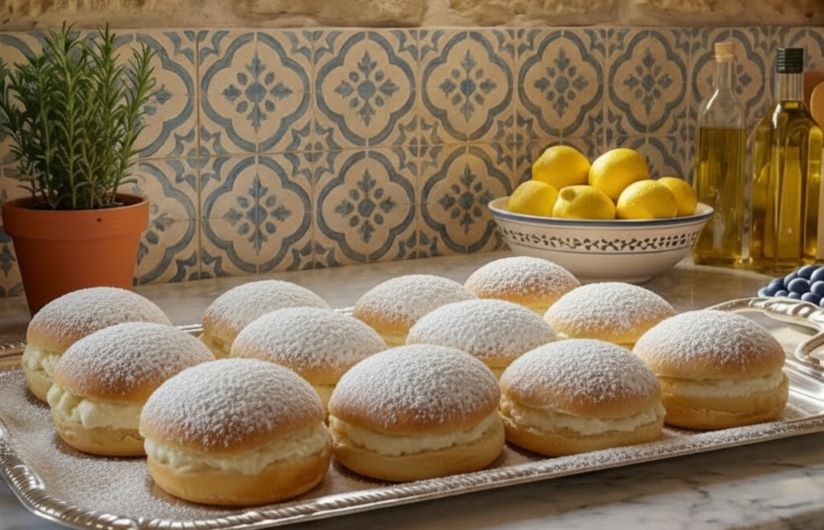
Tip: Let ricotta sit in a fine-mesh sieve for 30–60 minutes before using. Use Cold Cream for a Stable Filling: Heavy cream whips best when it’s very cold. Warm cream won’t thicken properly and may deflate when folded with the mascarpone mixture. Chill your mixing bowl too for extra fluff. Don’t Overbake the Brioche: Fiocchi di Neve should be soft, pale, and tender—not brown like dinner rolls. Pull them out as soon as the tops turn a light blonde color. Overbaking makes the shells dry and crumbly. Keep the Dough Slightly Sticky: This dough is naturally soft and a bit tacky. Resist the urge to add too much flour. A sticky dough = softer, cloud-like results. Weight Measurements Give the Best Results: Although cups work, weighing ingredients (especially flour) gives the most consistent texture. Brioche is sensitive to measurement differences, so a scale is your best friend. Let the Dough Rise in a Warm, Draft-Free Spot: Brioche likes gentle warmth. If your kitchen is cold, place the covered bowl in the oven with the light on it creates the perfect proofing environment. Fill Only When Completely Cool: Warm pastries will melt the filling, causing it to thin out or seep. Make sure the brioche buns are fully cooled before piping. Be Generous with the Filling: A true Fiocco di Neve isn’t skimpy! The pastry should feel slightly heavy for its size when filled—this gives you the authentic, creamy center.
Tip: Let ricotta sit in a fine-mesh sieve for 30–60 minutes before using. Use Cold Cream for a Stable Filling: Heavy cream whips best when it’s very cold. Warm cream won’t thicken properly and may deflate when folded with the mascarpone mixture. Chill your mixing bowl too for extra fluff. Don’t Overbake the Brioche: Fiocchi di Neve should be soft, pale, and tender—not brown like dinner rolls. Pull them out as soon as the tops turn a light blonde color. Overbaking makes the shells dry and crumbly. Keep the Dough Slightly Sticky: This dough is naturally soft and a bit tacky. Resist the urge to add too much flour. A sticky dough = softer, cloud-like results. Weight Measurements Give the Best Results: Although cups work, weighing ingredients (especially flour) gives the most consistent texture. Brioche is sensitive to measurement differences, so a scale is your best friend. Let the Dough Rise in a Warm, Draft-Free Spot: Brioche likes gentle warmth. If your kitchen is cold, place the covered bowl in the oven with the light on it creates the perfect proofing environment. Fill Only When Completely Cool: Warm pastries will melt the filling, causing it to thin out or seep. Make sure the brioche buns are fully cooled before piping. Be Generous with the Filling: A true Fiocco di Neve isn’t skimpy! The pastry should feel slightly heavy for its size when filled—this gives you the authentic, creamy center.
Nutrition Estimated Facts
Fiocco di Neve
(Neapolitan Snow Puff)
Serving Size: 1 pastry (Approx. 90g)
| Nutrient | Amount | % DV |
|---|---|---|
| Calories | 320 kcal | — |
| Total Fat | 14 g | 18% |
| Saturated Fat | 8 g | 40% |
| Cholesterol | 55 mg | 18% |
| Sodium | 160 mg | 7% |
| Total Carbohydrates | 40 g | 15% |
| Dietary Fiber | 1 g | 4% |
| Added Sugars | 22 g | 44% |
| Protein | 7 g | — |